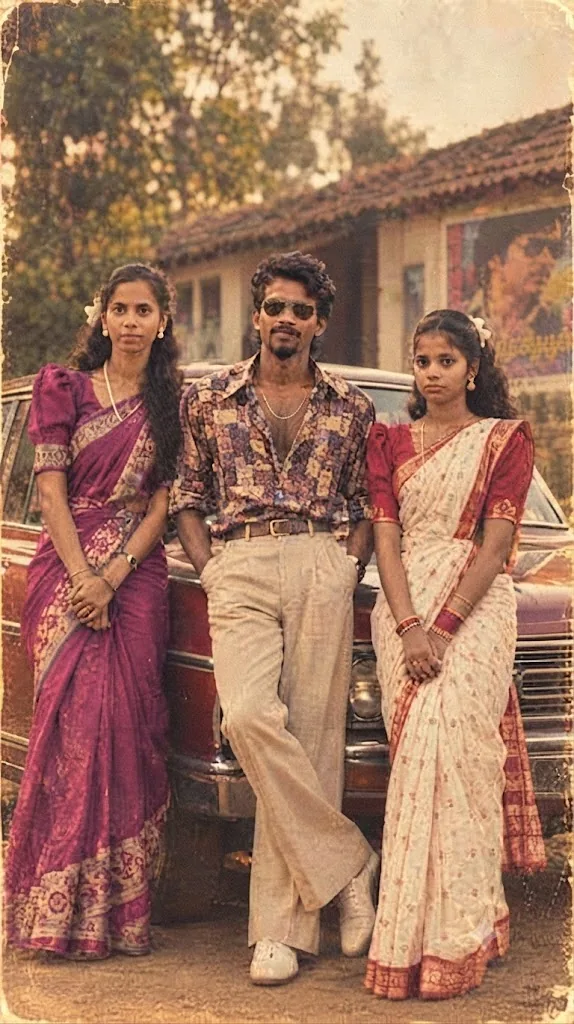
The Retro Film Still: A 1970s South Indian Period Portrait
Style breakdown
This photograph is a detailed reconstruction of a 1970s indoor/outdoor portrait, designed to evoke powerful nostalgia. The prompt is engineered to translate not just the subjects' likeness, but the entire cultural context and fashion aesthetic. Key elements—such as the specific patterned shirt, the flared denim jeans, the aviator sunglasses, and the traditional silk sarees—are critical for establishing the decade's identity. The setting is not just a generic location but an explicitly detailed "weathered, yellow-ochre building" with a specific tiled roof, adding layers of narrative depth. The presence of the partial film poster further grounds the scene. The lighting is engineered to simulate a typical outdoor daylight scene which flattens the contrast and enhances the retro feel. Crucially, the prompt specifies authentic analog artifacts like film grain, specific color shifts (towards warm sepia tones), and a distressed border, making the final output indistinguishable from a genuine 1970s film photograph. This approach bridges cultural storytelling with strict technical compression parameters to ensure the final asset is optimized for digital use, strictly adhering to the 1 MB storage limit.
The prompt
A meticulously styled, professional color photograph, replicating the authentic aesthetic of a 1970s analog film still, capturing the central man and the two women from image_228.png. The man stands centrally, leaning casually against a dark red vintage car (like a classic Ambassador or Fiat Padmini), wearing the identical patterned long-sleeved shirt, light-wash denim flared trousers, gold chain, and aviator sunglasses. The two women stand on either side, mirroring their poses and traditional South Indian silk sarees. The woman on the left wears the same purple saree with gold and pink details. The woman on the right wears the same cream and red Kanchipuram saree. They are positioned against the backdrop of the weathered, yellow-ochre building with its characteristic tiled roof, exactly as in image_228.png. A vintage South Indian film poster is partially visible on the wall. The entire image exhibits period-correct, heavy film grain, slight color fading towards warm sepia tones, and soft, diffused daylight. The photograph is framed by a distressed, aged film border with slightly yellowed, worn corners and a subtle filmstrip perforation edge.
How to use
Copy the complete prompt text provided above into your preferred advanced AI image generator or studio rendering workspace. Ensure your generator's settings are configured to a standard portrait aspect ratio (such as 4:5) to properly frame the three subjects and their environment. Adjust the "Style Reference" or "Image Weight" settings (if available) to prioritize the likeness of the individuals while applying the film texture and clothing patterns from the prompt text. Set your target resolution to high fidelity to capture the fine film grain and fabric textures of the denim and silk sarees. Adjust lighting parameters to emphasize the soft, natural daylight for flattering skin tones and deep, rich colors, avoiding harsh, clinical light. Set your export format (JPEG/WebP) and compression settings to guarantee the final output image file size is compressed down to 1 MB or less. Generate initial renders and inspect critical details: check for the correct clothing patterns on all three subjects, confirm the presence of the sunglasses and gold chain, and verify the presence and quality of the aged film border. Refine or re-run the prompt if the film texture is too heavy or if the likeness requires more precision. Export the final chosen render as a high-quality digital file, suitable for use in a heritage brand lookbook, a vintage fashion advertisement, or a nostalgic social media campaign, strictly at or below the 1 MB storage limit.