The 1970s Stroll: Vintage Indian Portrait
Style breakdown
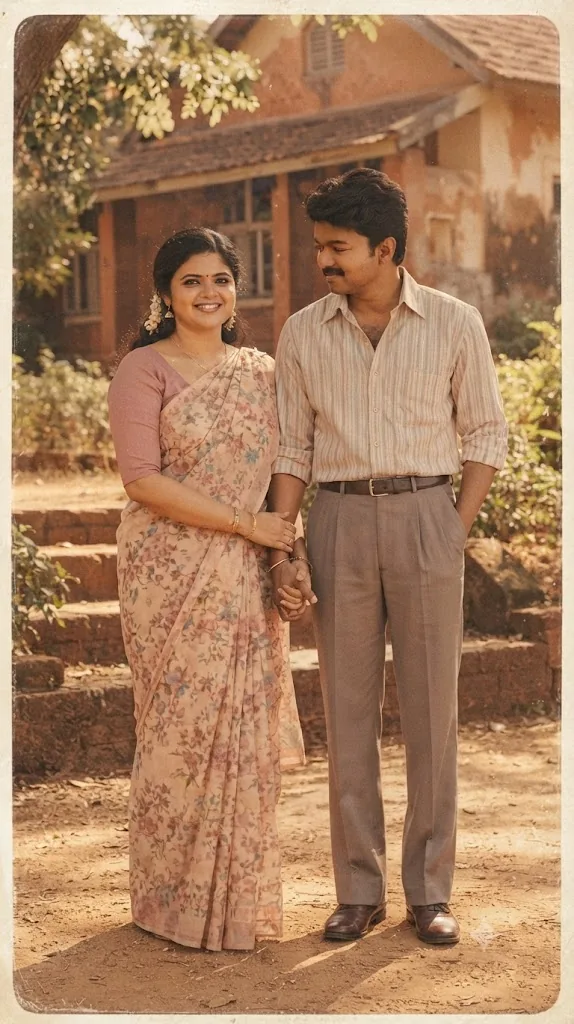
This photograph is a detailed reconstruction of a 1970s-era family portrait, designed to evoke powerful nostalgia. The prompt is engineered to translate not just the subject's likeness, but the entire cultural context. Key elements—such as the specific high-waisted pleated trousers, the floral chiffon saree, the gajra (white flowers) in the hair, and the period-correct hairstyles—are critical for establishing the 70s identity. The setting is not just a generic street but an explicitly detailed "sun-dappled garden" with terracotta steps and a traditional Indian house, adding layers of narrative. The lighting is engineered to be warm and diffused, simulating the golden hour of a tropical afternoon. Crucially, the prompt specifies authentic analog artifacts like film grain and color shift, making the final render indistinguishable from a genuine 1970s film photograph. This approach bridges cultural storytelling with strict technical compression parameters to ensure the final asset is optimized for digital use, strictly adhering to the 1 MB file size limit.
The prompt
A professional color photograph, meticulously styled as an authentic 1970s-era portrait of a South Indian couple, standing side-by-side outdoors on a sun-drenched dirt path. The man, on the right with his hair styled in a 70s cut and a mustache, looks affectionately at the woman. He wears a light beige striped button-down shirt, high-waisted taupe pleated trousers with a dark leather belt, and brown leather shoes. The woman, on the left, smiles warmly at the camera, wearing a delicate, floral-patterned chiffon saree in peach and blue tones with a matching pink blouse. Her hair is styled with white flowers (gajra) and simple gold earrings. They are holding hands. The background is a sun-dappled garden with old, terraced brick steps, lush green foliage, and a traditional, sun-baked South Indian house with a tiled roof. The entire image features period-correct film grain, a soft, warm sepia-toned color cast, and a distressed, aged photo border with rounded corners.
How to use
This photograph is a detailed reconstruction of a 1970s-era family portrait, designed to evoke powerful nostalgia. The prompt is engineered to translate not just the subject's likeness, but the entire cultural context. Key elements—such as the specific high-waisted pleated trousers, the floral chiffon saree, the gajra (white flowers) in the hair, and the period-correct hairstyles—are critical for establishing the 70s identity. The setting is not just a generic street but an explicitly detailed "sun-dappled garden" with terracotta steps and a traditional Indian house, adding layers of narrative. The lighting is engineered to be warm and diffused, simulating the golden hour of a tropical afternoon. Crucially, the prompt specifies authentic analog artifacts like film grain and color shift, making the final render indistinguishable from a genuine 1970s film photograph. This approach bridges cultural storytelling with strict technical compression parameters to ensure the final asset is optimized for digital use, strictly adhering to the 1 MB file size limit.