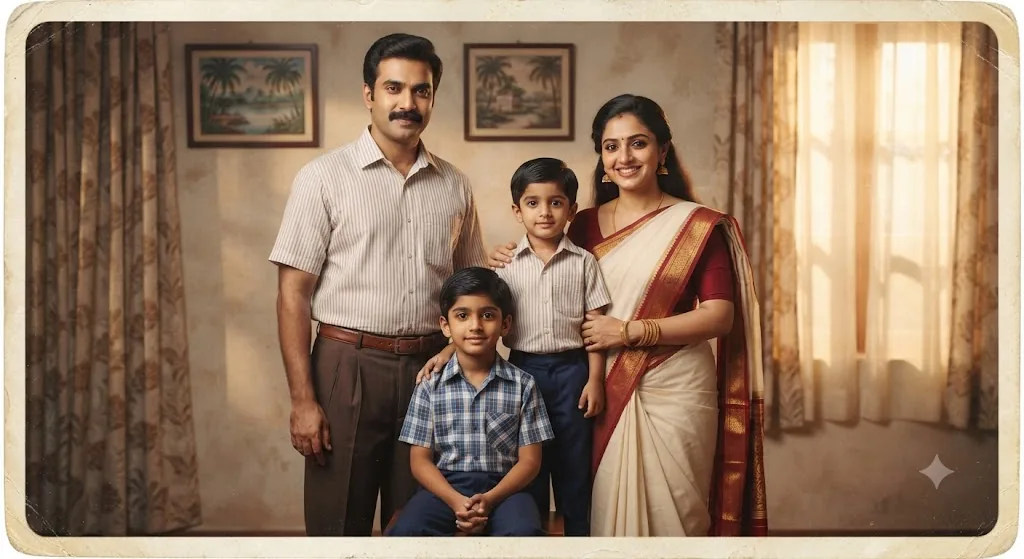
The Heritage Print: A 1980s Indian Family Portrait
Style breakdown
This photograph is a detailed reconstruction of a 1980s-era indoor portrait, capturing the classic aesthetic of Indian family photography from that decade. The prompt is engineered to translate both individual likeness and contextual cues, such as the characteristic painted studio backdrop (which I've defined as a textured wall with specific decor) and structured family posing. Key elements—including the brown blazer paired with an open-collared shirt, the silk saree with specific border colors, and the affectionate family embrace—establish the authentic cultural and temporal setting. Studio portraits from the 1980s often utilized soft, diffused light to create a warm, nostalgic glow. The technical parameters specify analog artifacts like fine film grain, slight color shifts, and a distressed border to mimic the look of a physical, cherished photograph preserved in a family album. This approach combines narrative emotional storytelling with strict technical formatting to ensure the final output fits seamlessly within a curated vintage collection while staying optimized under a 1 MB file size constraint.
The prompt
A meticulously styled, full-color portrait of a South Indian family, based on the likenesses and composition of image_193.png. The father, on the left, stands tall in a light-colored striped short-sleeved shirt and dark brown pleated trousers with a leather belt. The mother, on the right, smiles warmly, wearing a traditional Kerala saree (off-white with a rich red and gold woven border) and a deep red blouse, accessorized with jhumka earrings and gold bangles. She has her arm around the younger son in the center, who wears a smaller version of the father's striped shirt and dark blue trousers. The older son, in front of the father, wears a blue and white plaid shirt and dark blue trousers. They are posed closely together indoors against a textured wall with patterned curtains and a vintage framed picture of a tropical scene, replicating the setting of image_193.png. The lighting is soft and warm, simulating natural golden hour daylight filtering through a window. The entire image has authentic 1980s analog film grain, a soft, natural color cast (Kodachrome aesthetic), and is framed by a distinctly distressed, aged photo border with rounded, yellowed corners and subtle fading, as if preserved in a cherished family album.
How to use
Copy the complete prompt text provided above into your preferred advanced AI image generator or studio rendering workspace. Ensure your generator's settings are configured to a standard vertical portrait aspect ratio (such as 4:5) to properly frame the standing and seated subjects. Adjust the "Style Reference" or "Image Weight" settings (if available) to prioritize the likeness of the family members while applying the film texture and backdrop details from the prompt text. Set your target resolution to high fidelity to capture the fine film grain, fabric textures (saree, plaid), and clothing details. Adjust lighting parameters to simulate a vintage studio setup with soft directional light and a warm color cast. Set your export format (JPEG/WebP) and compression settings to guarantee the final output image file size is compressed down to 1 MB or less. Generate initial renders and inspect critical details: check for the correct expressions and postures, confirm the color accuracy of the saree border, and verify the presence and quality of the aged film border. Refine or re-run the prompt if the film texture is too heavy or if the likeness requires more precision. Export the final chosen render as a high-quality digital file, suitable for use in a heritage brand lookbook or a vintage-themed digital gallery, strictly at or below the 1 MB storage limit.